

Spain Secured Justice for Football in 2 Separate Ways
The 2026 World Cup final was a black eye for Argentina, but in the end this tournament mostly weathered the nastiness and cynicism to be the stage for titanic human stories.
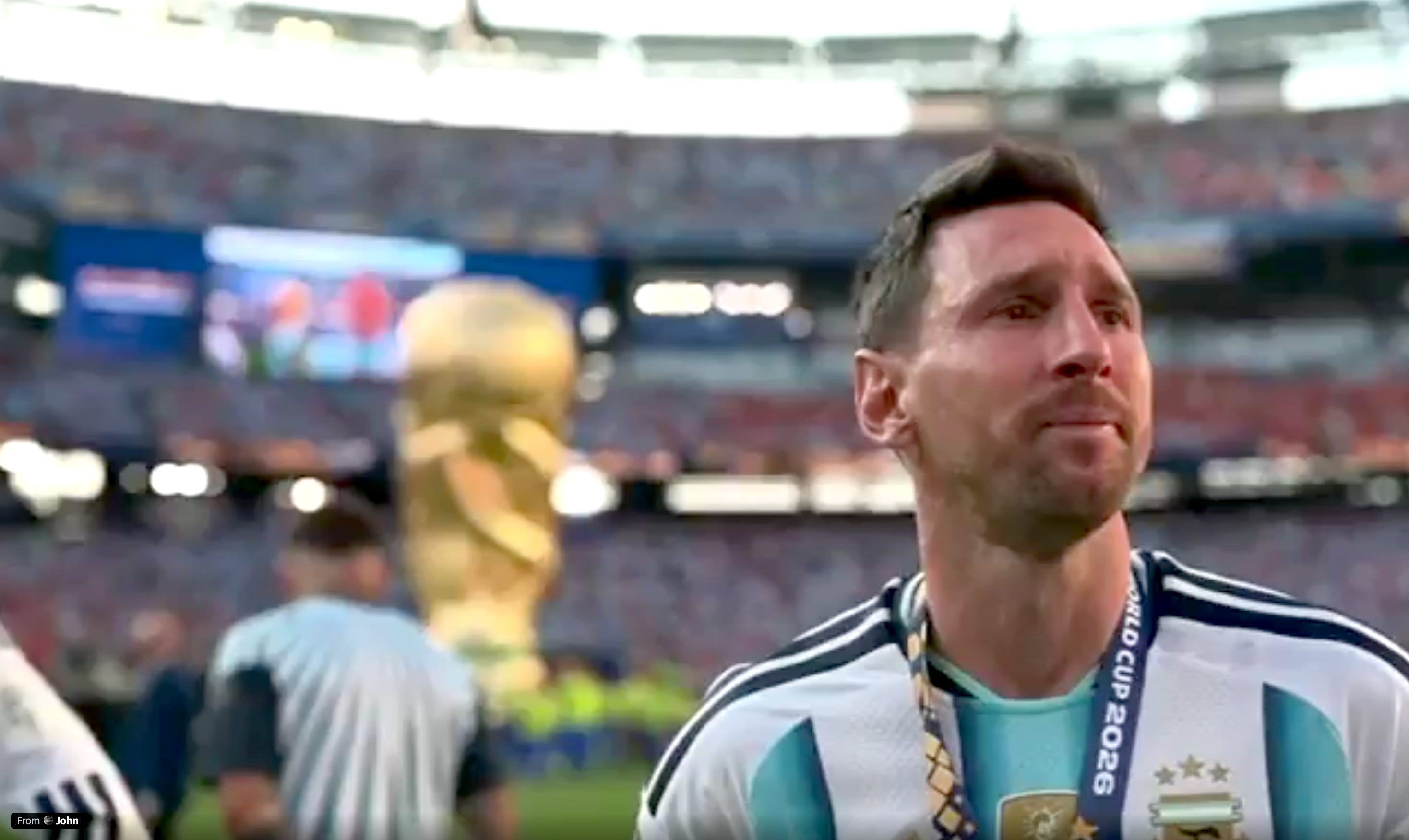
Messi wept. He looked out on the mass of blue and white in the stands and they cheered his name and he cried. The greatest player had lost the World Cup. He could not rescue his nation one last time.
In truth, Argentina were terrible. They were struck down by a volley from Ferran Torres in extra time, but it could have been more. It could have been worse. The Argentines mustered almost nothing as far as threats to the Spanish goal, they could scarcely keep the ball at all for large stretches of the World Cup final, and they tried to make up for a lack of footballing endeavor with cheap antics and shithousery. It was a black eye for the defending world champions and for their outstanding individual, Lionel Messi, who failed to make an impact.
Was it about systems or players? That was the essential question asked by this final, and perhaps by the tournament in general. Historically, the World Cup is about providing a stout platform for your outstanding individuals to go out and win the game for you, and Argentina represented that legacy. It’s not to say they had no shape or structure—they spent most of this match in a shell—but Spain were the team that played like a club team: They had a cohesive system that summoned more from them than the sum of their very talented parts. They trusted their collective quality to defeat a very different team. Argentina had hurtled towards the final on a roller coaster with significant G-force, riding their luck and their moments of quality to the big show in New Jersey.
Ultimately, they were found out. This final was wild to watch, and not just because of the Albiceleste antics. It could easily have been 3-0 Spain in extra time, just fruits for their complete domination of the match, and yet Argentina were living on their umpteenth reprieve of this tournament—the cat’s tenth life. One goal was ruled out for a ticky-tack foul in the buildup, the other for a decision from the semiautomatic offsides system that was hastily shown on the TV broadcast. Despite everything, Messi’s men were just one goal, one sorcerous moment away from pushing it to penalties. They’d lost a man when Enzo Fernández earned a silly sending off, but while the great one still wears the blue and white stripes, anything is possible. Spain could get sniped, the game turned on its head in an instant.
But Messi could not do it. Argentina were desperately poor, and Spain calmly asserted themselves as what they are: a class above. I was at a bar in downtown Manhattan for the match, and my friends and I reminisced on those Spain teams, 2008-2012, the greatest assembly of players in football history, many of whom were in the crowd for this one. This team is not quite that (though people forget how many 1-0 games those famous Spain teams won at major tournaments), but the current crop have serious technical quality and follow a tactical plan that has proven impenetrable across 38 unbeaten matches. Their manager Luis de la Fuente doesn’t just know Spanish football inside and out—he’s writing a new chapter of the book, and it’s a story of collective excellence. They defend at a high level and get their goals when they need them.
That’s why I thought France would do it: They keep the opposition away from their own goal and they have killers in attack, guys who can pop in 1-2-3 goals in no time. But Spain classed them in the semifinal just like they did at EURO 2024, controlling territory and passing the French to death. They conceded just one goal and 10 shots all tournament. They didn’t require individual heroics from Lamine Yamal in either of the final two rounds. Their goals felt inevitable: Their footballing machine just churned them out. They controlled proceedings and earned victory. They are the world’s best team.
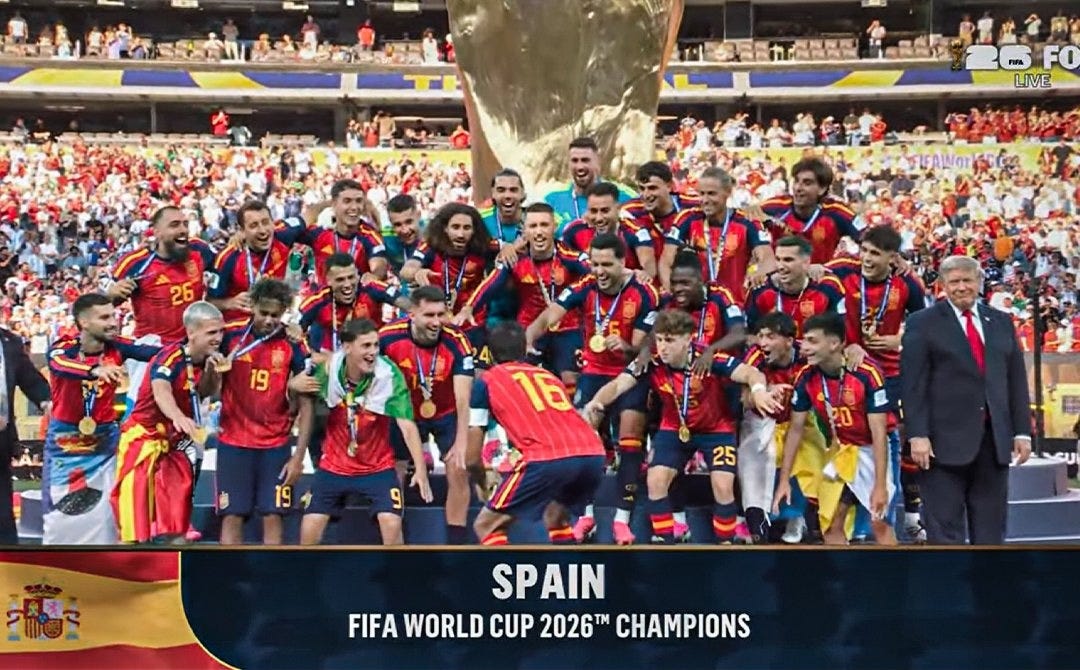
For that, they were presented with the World Cup trophy in circumstances befitting this tournament. The presidents of FIFA and the United States came ambling to the podium under a barrage of boos, the latter with his mopey Serious Face on, and they proceeded to inject themselves into the proceedings as much as possible.
Trump held a referee’s hand for a truly strange length of time, knowing the cameras were trained on him and that they carried with them the attention of billions of people across the world. That turned out to be a theme. When it came time to hand over the trophy, Gianni Infantino took it off the stand and half-handed it to Trump as they shuffled together towards the Spanish players, sharing a grip on the gold. Trump sought to chat with everybody in eyesight, mostly failing at interlingual small talk but keeping himself in the frame as long as he could. He finally wandered over to the edge of things, still lingering in the camera shot as Infantino scurried across the stage after him and tried to get him out of the picture before Rodri lifted the World Cup for his nation. The FIFA chief did not quite succeed, but in many of the photos on Spain’s social media, Trump has been edited out.
That is what Spain and all the nations who assembled here have had to do: overcome the ridiculous trappings of this tournament to get out on the field and express themselves. In the end, the beauty of this human phenomenon was irrepressible, which is what makes this game so attractive to the politicians and corporates looking to sell an image of themselves or their products. It’s a thrilling ride, an explosion of human emotion in all its many forms, and few of us can avoid getting lost in it: Cape Verde, DR Congo, a teenage Gilberto Mora shining for Mexico against England in the Estadio Azteca, the Viking row and the star-studded chase for the golden boot. This wasn’t a great final, but Spain’s players harnessed this tournament as every nation’s ought to: as a vehicle for self-expression in the pursuit of glory.
“I struck it with all the power of the Spanish people,” Ferran Torres said of his winning strike in an interview afterwards. It said everything. The great Spanish machine had rolled through the Argentines and everybody else on the pitch at this tournament. It had also risen above the almighty noise of this particular World Cup, all the rampant American transactionalism, the cynical politicking, the blaring signals that not all was above board. In the end, there was justice for football, and it was all about the stories of men.
“He had moments where he was human,” Zlatan Ibrahimović said of Messi as footage of the weeping greatest filled the FOX broadcast. “He had moments where he was not human.” The GOAT’s last dance on the World Cup stage was not one of the latter. Messi was a mortal man after all, run over by the Spanish machine. A titan of sporting history is now making way, exiting the piece. Will anyone succeed him, or will football’s age of mythic heroes go with him?