

José Mourinho Interview + A Few World Cup Thoughts
Chatting with the Special One; catching the World Cup bug as the knockout stage looms; plus: Lionel Messi, Cristiano Ronaldo, Team USA, and the FOX broadcast team.
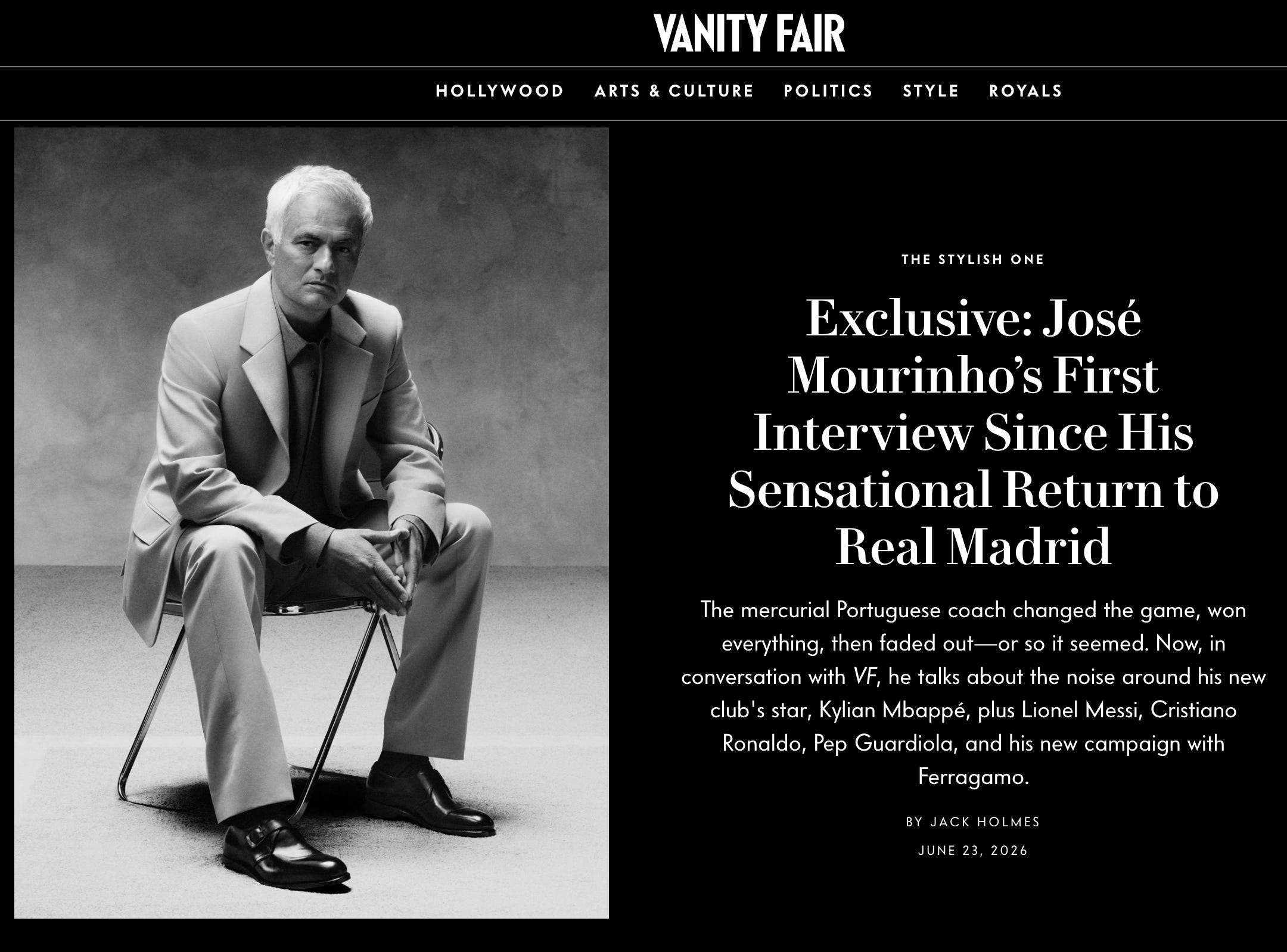
I always feel like there are a million other questions I should’ve asked. I’ve been fortunate to chat with a few sporting luminaries over the years, and while it’s often a difficult task—athletes are media-trained specifically to avoid making headlines off the field—there’s also tremendous opportunity in it. I just usually come out of these things thinking, “Did I forget about X and Y, and is the whole thing less than it could have been?’”
The stakes are ratcheted up with somebody like José Mourinho. Words like “legend” and “enigma” are overused, but the mercurial Portuguese won eight league titles and two Champions League medals coaching teams in London, Milan, Madrid, and beyond, all while staying largely unknowable. He was a force of nature at a press conference and in the heat of battle on the pitch, a schemer with a sharp tongue who proudly declared that winning was the only thing. He is possibly the only person to successfully coin their own nickname, convincing the English media and the rest of the football world to call him “The Special One” after he said it first. He’s lived a hundred lives in this game.
Should I ask him what he’s going to do about the Kylian Mbappé situation at Real Madrid—the worldwide gigaclub to which Mourinho made a sensational return this month after years in the relative wilderness? What about his rivalry with Pep Guardiola, when the two of them were stars in El Clásico alongside Lionel Messi and Cristiano Ronaldo in modern football’s greatest rivalry?
Those things I did ask him about, plus his views on all the criticism Arsenal faced for their “anti-football” this season and whether it reminded him of the guff his teams got. Luckily, I seem to have done enough, and the interview spawned headlines across the world—from Marca to L’Equipe to ESPN. Check it out.

COLOMBIA vs PORTUGAL WAS CLASSIC WORLD CUP FARE
In the summer of 2006 I was off from school and watched every match from the FIFA World Cup in Germany. OK, I probably missed a few, but I saw Didier Drogba and Côte d’Ivoire battle Argentina and the Netherlands in the group of death. I watched Zinedine Zidane go transcendent for France, Italy reach the crescendo of Catenaccio, Lionel Messi’s debut, Cristiano Ronaldo baiting Manchester United teammate Wayne Rooney into a daft sending off. It was formative stuff.
20 years later, I’ve found it harder to launch myself into the World Cup in the same way, at least in the group stage. I’ve watched less than 10% of the matches. Part of that is having to be in an office four days a week, part of that is the sheer number of games in the expanded format, part of it is exhaustion after the emotional trial that was Arsenal’s season and with the grotesquery of the modern football authorities. Still, I knew I’d get the bug, and COLOMBIA vs PORTUGAL last night was just what the doctor ordered.
The Colombia fans were traveling in force, as usual, and as usual they were loud. The winner of this one would take the group. Well, Colombia would be fine with a draw, but the Portuguese needed three points. The latter were always likely to take control in midfield, and Colombia were happy to keep their shape until they won the ball in a decent area and it came time for the yellow shirts to flow forward at stunning speed.
The dominant story was of course the involvement of Cristiano Ronaldo after up-and-down performances at this tournament. It wasn’t a question of whether he would be involved—head coach Roberto Martínez seemingly can or will not ever drop him—but whether his involvement would truly benefit his team. Since he doesn’t contribute on other sides of the game much, he needed to score goals, and the expectations shot through the roof when he stood over a free kick early in the first half. He bounced a tame effort at the keeper’s feet.
Chances were few and far between, but it was a classic high-level tournament encounter: tons of pace, technical quality in the passing game, clever movement and some good patterns of play. In the age of G/A, where many people seem to process football through Instagram, some of us still know there are fuego 0-0 draws in this game. Colombia had a 92nd-minute winner ruled out by an offside toe, then Rafael Leão burst into the box for Portugal but put it wide on 93 minutes.
Portugal have one of the world’s great teams, but Colombia have also been in that contingent over the last few years. FIFA ranks Los Cafeteros 11th in the world for good reason, as they’re easily #3 in South America—and maybe giving Brazil a run for their money.
THE STORIES ARE COMING
While all that was going on, DR Congo secured qualification to the knockout rounds with a comeback win against Uzbekistan in Atlanta. It’s a dramatic improvement on the nation’s last World Cup showing 52 years ago. Back then, they were called Zaire. Check out Franklin Leonard’s story on the DRC ahead of the tournament—he spoke with one fan who planned to bring his father and his own son to make that game last night in Atlanta a trigenerational affair.
As much as many of us groused about the expanded format, there have been some refreshing additions to the 48-team field—it’s been glorious to see new nations make their mark on this storied tournament—and having third-place teams qualify has been a treat. It’s created a mini-table of teams as the group stage comes to a conclusion—a new subplot. Cabo Verde were already a great story, but now they’ve qualified for the Round of 32 and will face the world champions, Argentina.
There were too many group stage games for me, but now the competition’s getting right-sized and there are some heaters:
NETHERLANDS vs MOROCCO
BELGIUM vs SENEGAL
PORTUGAL vs CROATIA
CÔTE D’IVOIRE vs NORWAY
MEXICO vs ECUADOR
ENGLAND vs DR CONGO
COLOMBIA vs GHANA
MESSI CHECKS IN
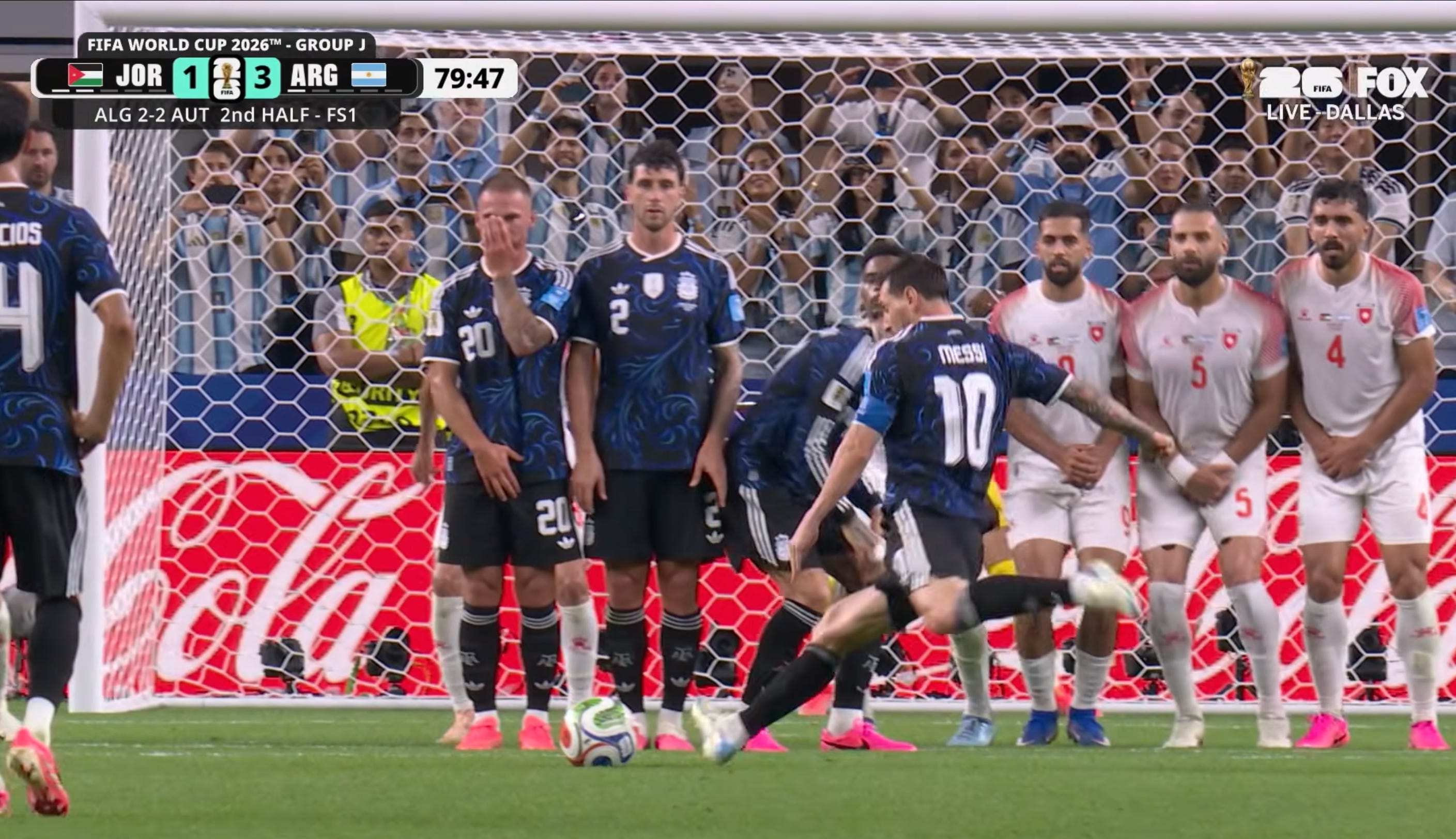
He took the first 60 minutes off. The Argentina fans were bouncing anyway in Dallas, Texas, singing their hymns as they did. The Argentines were massive, but the small sections of Jordanians got into it as well with a vaguely Viking “WHOOF!” as they all clapped at once in hastening rhythm. They did their best to make noise in a sea of albiceleste.
Then Lionel Messi showed up and smashed in a free kick. The Jordanian keeper was poor, cheating away from his post just as he had for Giovani Lo Celso’s dead-ball opener. But the great one had scored again nonetheless and became the first player ever to score in seven consecutive World Cup matches. He also took a commanding lead in the Golden Boot race, and the guest list there suggests (nearly) all the stars have shone in North America this June:
LIONEL MESSI — 6
KYLIAN MBAPPÉ — 4
OUSMANE DEMBÉLÉ — 4
VINÍCIUS JUNÍOR — 4
ERLING HAALAND — 4
HARRY KANE — 3
Meanwhile, while that was happening, Algeria and Austria were playing out a thrilling 3-3 draw where the Austrians were tossed out of the tournament then dragged themselves back into it across a few stoppage-time minutes. What a way to wrap the group stage.
FOX AMERICANS
I understand sending in the American commentators for USA games (and some others) but I do not understand FOX’s decision to fly John Strong and Stu Holden in for every big match. It’s not to say they’re useless—Holden is usually good—but the network has hired far more talented commentators for this tournament. Ian Darke and Derek Rae are a class above and should be calling the big encounters between major players in this competition.
British voices tend to have a better command of the English language in a football context, though Darren “Fletch” Fletcher’s comment that he and Owen Hargreaves “were lucky enough to share a restaurant with Prince Ali of Jordan” was a strange one. Hargreaves was showing ball knowledge on Nico Paz, though. I hope Arsenal go get him this summer.
TEAM USA
It’s a complicated time to be an American, and anyone dishing out unabashed patriotism at this hour of empty fireworks ought to sit down for a think. But watching the United States Men’s National Team play serious stuff as they sweep into the knockout rounds of a World Cup on home soil is a sight to see.
It helps to hire a serious manager, and Mauricio Pochettino is just that. He was always going to raise the level of the United States pressing game and their grasp of the pace and ebb and flow of matches at the top level. He has vast experience competing in major tournaments—high-pressure environments contending with skilled and savvy opponents.
Which isn’t to say the Americans have played top-level opposition yet, and that won’t change in the Round of 32. Bosnia and Herzegovina are no joke, but they’re not a serious force at this tournament either. The USA will be expected to carry the day and move on to a matchup with Senegal or Belgium. Then we’re cooking with gas.